

Most growing teams don’t go shopping for a traditional CRM. They go looking for clarity: clear pipelines, clear ownership, and reporting that doesn’t require a consultant on speed dial. If you’re comparing monday CRM and legacy options, you’re likely feeling the friction—the bloat and rigidity that make it seem like your CRM is running you instead of the other way around. Let’s break that down practically. No hype, no vendor bingo. Just the stuff that matters when you’re scaling.
Classic CRMs were built for big sales organizations with dedicated admins and long implementation cycles. They expect a one‑size‑fits‑all data model and often require specialized admins or consultants just to make simple changes. Guidance even suggests one Salesforce admin for every 75–100 users.
For a team of 10–200 people that means:
On paper, legacy CRMs look powerful. In practice they often slow teams down when speed matters most. Implementation timelines can range from two weeks to over a year; small deployments may go live in a month, but enterprise rollouts with multiple clouds and heavy customization often take six to twelve months or more. Those timelines grow as you add integrations and custom objects. Add‑on modules, seat minimums and extra storage further inflate costs. No wonder adoption lags.
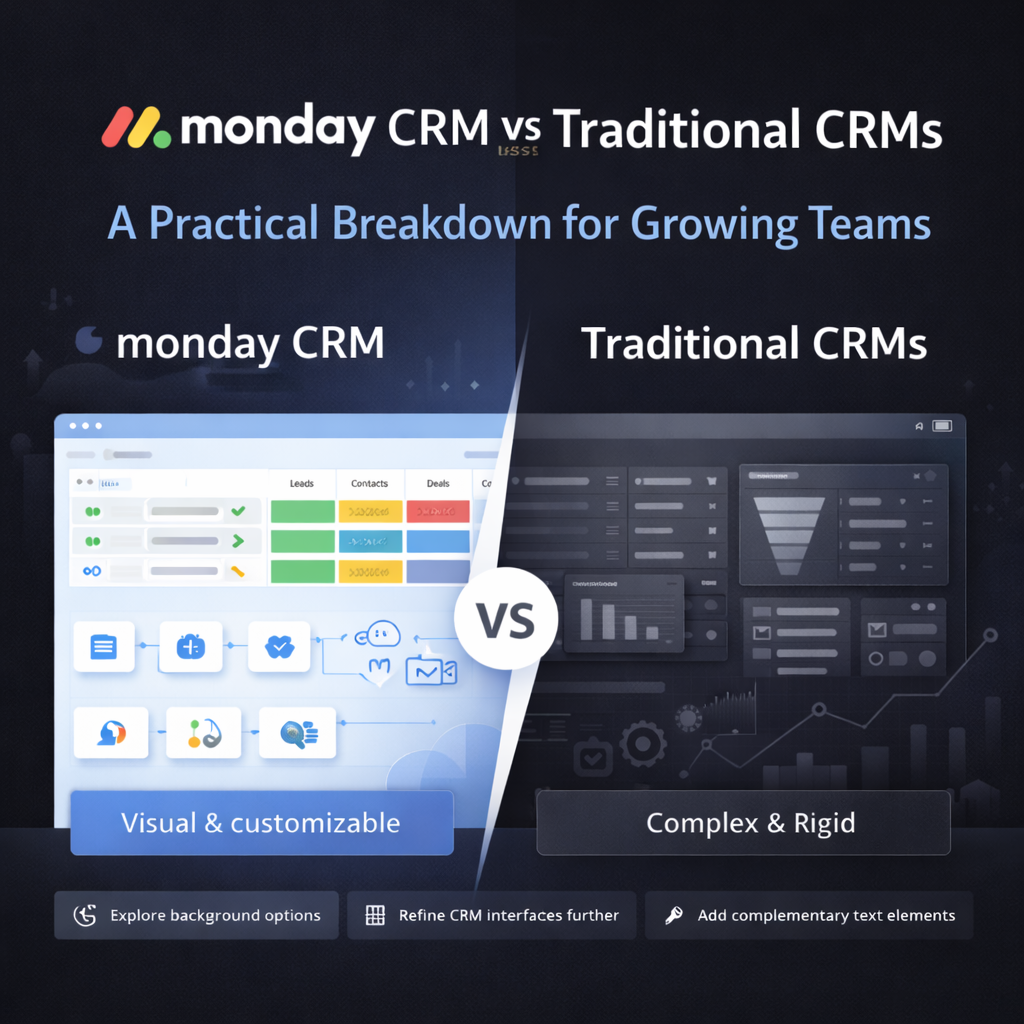
Traditional CRMs lock you into predefined objects, fields and workflows. Customizing them means working around the system instead of with it. monday CRM flips that model. You build your CRM the way your business runs. Boards, fields, views and automations are flexible by default, and you can customize them without a developer. It supports both pre‑ and post‑sales processes on one platform. That means sales, marketing and operations can work in the same system without being boxed into someone else’s definition of “best practice.”
A CRM only works if people actually use it. Legacy systems often need weeks of training and constant policing to maintain data quality. monday CRM feels familiar on day one. It behaves like a modern work OS rather than a database from 2008. The intuitive boards, color‑coded labels and drag‑and‑drop fields make setup easy. monday CRM walks you through board creation and the interface is self‑explanatory, leading to higher adoption and fewer complaints about clunky workflows.
“Go live” with a traditional CRM rarely means “productive.” There’s usually a long gap between deployment and real ROI. monday CRM is faster to configure and iterate. It’s up and running in minutes, and teams can launch a usable system in weeks, not quarters. You can iterate without breaking everything because changes don’t require code or specialized admins. In contrast, Salesforce implementations often require months and expensive customization.
Legacy CRMs tend to start reasonable and get expensive fast. Add‑ons, seat minimums and specialized modules inflate budgets. Hidden costs like storage and additional sandboxes can increase monthly fees by hundreds of dollars. monday CRM pricing is more transparent, with plans starting around $12 per seat per month on the Basic tier, including unlimited customizable pipelines and contacts. Higher tiers add features like email automations, sales forecasting, AI‑powered insights and unlimited contacts, scaling predictably for growing teams. You pay for what you use, not for features you tolerate.
We rank monday CRM as our top choice for growing teams because it balances power with usability. It’s not perfect for every scenario—enterprises with extremely complex compliance requirements or bespoke custom objects might still choose Salesforce or Oracle. But for most scaling organizations it hits the sweet spot.
monday CRM wins when:
Legacy CRMs still have their place. Very large, highly structured sales orgs with dedicated admin teams may need the advanced customization and industry‑specific modules these platforms provide. But for most growing teams, monday CRM delivers value faster, with less friction, and less resentment from the people who have to use it every day.
Most CRM failures aren’t about the tool; they’re about the rollout. At OrangeDot, we help teams:
Before you compare tools:
Choosing between monday CRM and traditional CRMs is less about features and more about fit. Growing teams need clarity, flexibility and speed. They need systems that support change instead of resisting it. That’s why we consistently recommend monday CRM as the best practical option for teams that want to scale without drowning in complexity. If you want help making that transition clean, strategic and actually usable, the experts at OrangeDot are here.