

Most teams don’t lack data.
They lack a clear way to see it.
As headcount grows, updates live in too many places.
Boards multiply, leaders scramble for reports, and everyone ends up guessing.
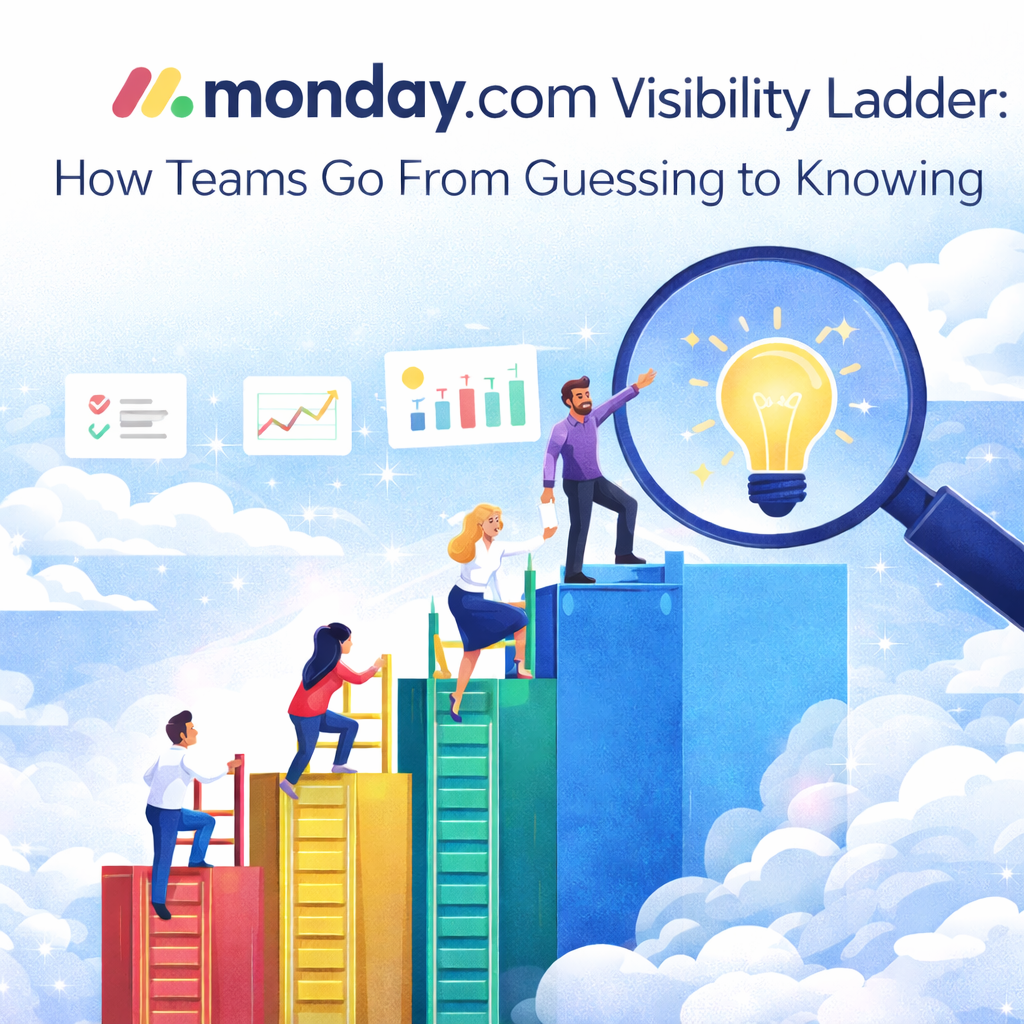
That’s why we created the monday.com Visibility Ladder.
Below we walk through the four rungs you climb to go from ad‑hoc updates to true insight.
In a small team, everyone knows what’s happening.
Tasks live in someone’s head or in a quick chat.
As projects overlap and leadership demands faster answers, you end up with:
This is when teams realize they’re operating on guesswork.
Visibility is not a switch; it’s a progression.
Think of visibility as a ladder.
Each rung builds on the previous one and unlocks a new level of clarity.
Most teams start here.
Status lives in conversations and meetings; it’s fragile.
Signs you’re on this rung:
Using monday.com without a structure leaves you here.
It’s not wrong, but it won’t scale.
This is where you start using boards properly.
Each board tells a clear story.
Statuses are consistent. Owners are defined.
Now you can answer questions like:
This stage feels good, but boards still live alone.
There’s no roll‑up across projects.
This is the turning point.
Work stops being viewed in isolation.
monday.com’s Connect Boards and Mirror Columns let you link items from other boards and display their data.
You can mirror multiple boards to see aggregated statuses in one place. Cross‑board automations even trigger actions in one board based on events in another.
At this stage you start to see:
Many teams stall here because their board structure isn’t consistent.
OrangeDot often steps in at this rung to fix that foundation.
This is the top of the ladder.
Executives don’t want boards; they want answers.
Dashboards pull live data from one or several boards and update automatically.
There are more than fifteen widgets for tracking budgets, workload, and progress.
An effective executive dashboard includes real‑time updates, data visualizations, customizable views, and drill‑down capabilities.
With a well‑built dashboard, leadership stops asking for manual reports.
They trust the system and act faster.
Most teams try to jump straight to dashboards and wonder why it fails.
We treat visibility as a system.
Our approach:
We don’t just build dashboards.
We build the ladder underneath them.
A solid visibility system makes these questions effortless:
If these answers require a meeting, there’s another rung to climb.
What is the monday.com Visibility Ladder?
It’s a four‑stage framework showing how teams evolve from manual status updates to executive dashboards.
Do I need dashboards to have good visibility?
Not at first. Dashboards only work well once board and cross‑board structure is solid.
Why do cross‑board reports break so often?
Usually because boards were built independently without shared structure or naming conventions.
Can OrangeDot help redesign existing boards?
Yes. Most of our work starts with cleaning up what already exists.
Visibility isn’t about more data; it’s about the right structure.
The monday.com Visibility Ladder provides a clear path from guessing to knowing without tearing everything apart.
Climb it intentionally and reporting becomes easy.
Decisions get faster.
Trust follows.
📢 Need help implementing this in monday.com?
Talk to a certified monday.com expert → Contact Us