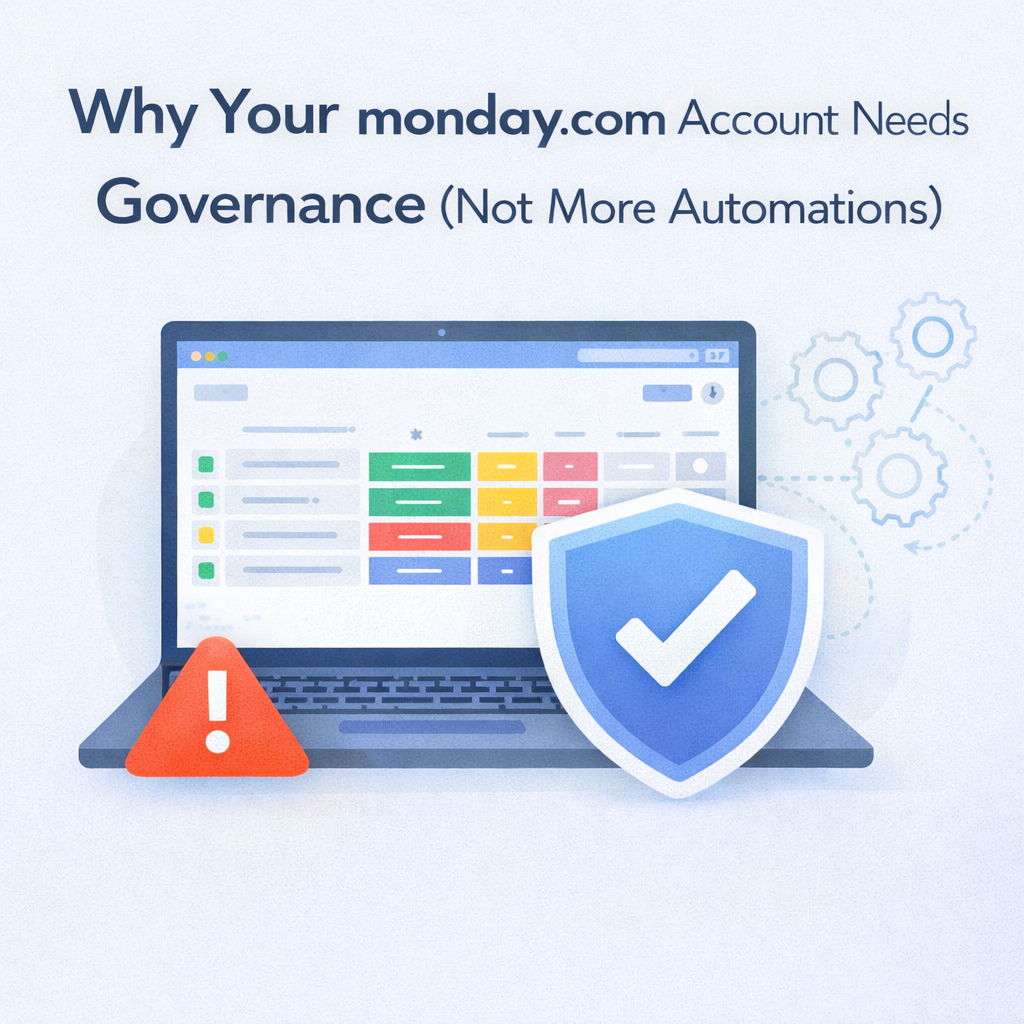


Most monday.com accounts don’t fail because they lack features.
They fail because they lack governance.
If you’re wondering why your monday.com workspace feels messy, slow, or hard to scale, you’re not alone. We see this every week. Teams add more automations, boards, and apps hoping to fix the problem.
It usually makes it worse.
Before you add anything new, let’s talk about governance and why it matters more than another automation.
monday.com is incredibly flexible.
That flexibility is both the magic and the danger.
Early on, teams move fast. Everyone builds their own boards. Naming conventions vary. Permissions are loose. Ownership is unclear.
At ten users, it feels fine.
At fifty, things start to crack.
At a hundred, the account becomes noisy, confusing, and fragile.
You might hear:
“I have no idea which board is the source of truth.”
“Automations keep breaking and no one knows why.”
“We’re paying for features but adoption is low.”
“Reporting is impossible because everything is inconsistent.”
This isn’t an automation problem.
It’s a governance problem.
Governance isn’t about locking everything down.
It’s about creating shared rules so your system can scale.
In monday.com, good governance covers several areas:
Every workspace, board, and automation needs an owner. Not a team. Not “everyone.” One accountable person. Board owners shape the board and manage access—inviting people, changing who else is an owner, and adjusting the structure. They can set or adjust board and column permissions, unarchive boards, and edit or delete automations. Without clear ownership, questions linger when something breaks.
Names are infrastructure. Boards, groups, columns, statuses, and automations should follow clear patterns. monday.com’s templates are fully customizable, from group names and status labels to automation recipes. When naming is inconsistent, reporting breaks and onboarding slows down. When naming is consistent, the system teaches itself.
Not every board should be built from scratch. Governed accounts use templates and standard board types like:
Templates help enforce structure and reduce rebuilds.
Open by default feels collaborative—until it isn’t. Board owners bypass permissions, but everyone else needs guardrails. Governance defines who can build, edit, archive, and automate. Role-based permissions protect sensitive data.
Automations are powerful. Too many unmanaged automations are dangerous. monday.com sets a limit on triggers and actions per minute. Complexity limits cap the amount of actions your account can do in a period. Hitting these limits leads to failures and delays. Governance defines when to automate, how to name automations, and who can create them. Simplifying workflows helps avoid rate limits.
Automations amplify whatever structure already exists. If your structure is messy, automations scale the mess. We see accounts with hundreds of automations doing things like:
Without governance, automations become technical debt. monday.com’s rate limits are hit when automation loops or batch actions trigger many recipes. Complexity limits can delay or cancel actions. You end up afraid to touch anything because a small change might break ten workflows. That isn’t what monday.com should feel like.
At OrangeDot, we start almost every engagement the same way: we audit governance before we touch automations. Strong governance keeps automation accurate, scalable, and aligned with organizational goals. Clear ownership prevents outdated workflows, risk exposure, or conflicting rules. We look at:
Once governance is in place, automations work better. Reporting becomes reliable. Adoption improves. Teams trust the system again.
This is how monday.com scales from a task tool into a true operating system.
Want quick wins? Start here:
You don’t need to rebuild everything at once. Create rules and stick to them.
monday.com governance is the set of standards, ownership rules, and structures that keep your account scalable, secure, and easy to use as your team grows. Strong governance ensures automations align with organizational goals and prevent risk.
Yes. Governance is easier to set up early than to fix later. Even teams of ten benefit from basic standards and ownership.
Admins play a key role, but governance works best when paired with documented standards, executive alignment, and clear ownership. monday.com board owners can adjust board structure and permissions, but cross-team coordination still matters.
No. Good governance protects flexibility by preventing chaos. Standard naming conventions and role-based permissions keep automations accurate and scalable. Teams enjoy freedom within clear boundaries.
If your monday.com account feels bloated, confusing, or fragile, the answer is probably not another automation.
It’s governance.
Standards scale. Ownership clarifies. Structure compounds.
When governance comes first, monday.com becomes easier to use as you grow, not harder.
Need help implementing this in monday.com?
Talk to a certified monday.com expert → Contact Us